

Skip to content

Topic

Judiciary and public administration

Electronic case files, digital procedures and the first AI applications are changing how courts and authorities work. The Hub brings the judiciary and public administration into dialogue with law firms and providers.

Last updated: · Editorial team, German Legal Tech Hub

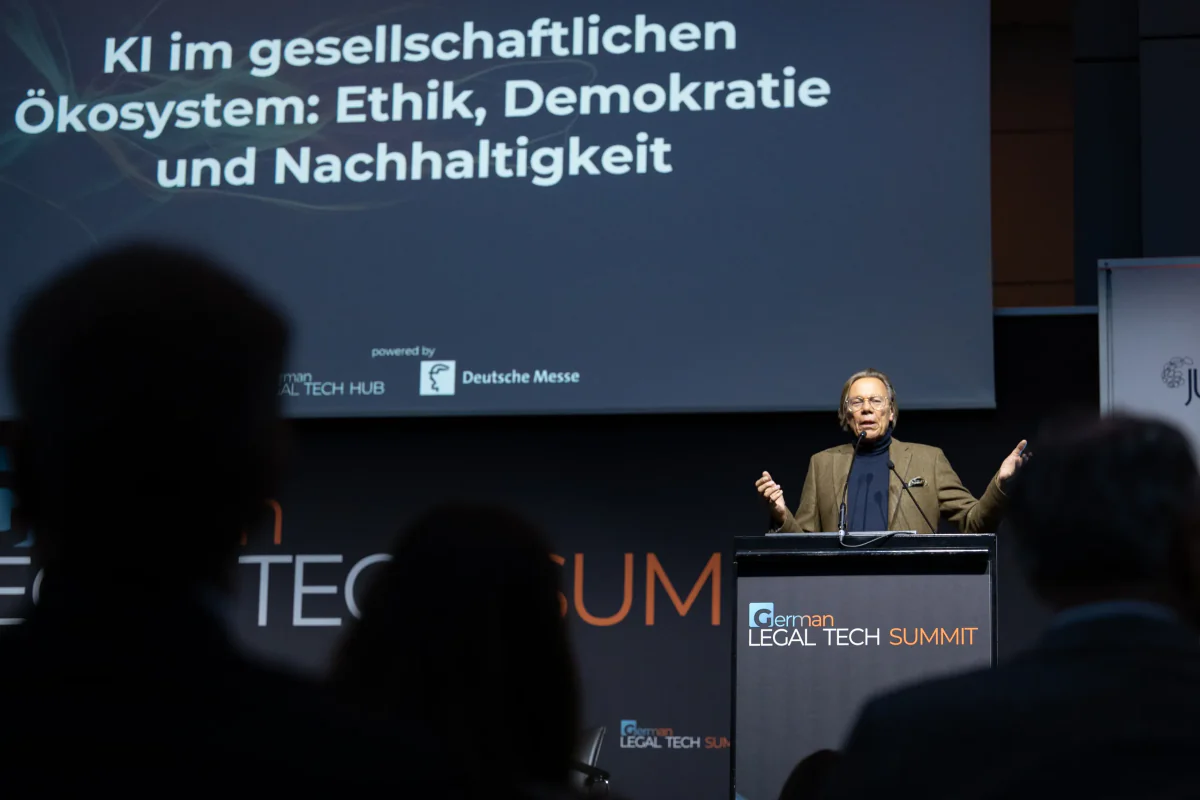
View from the audience towards a speaker at the lectern, with the screen above reading “AI in the Social Ecosystem”

ContextWhat it's about

The judiciary is switching to the electronic file; the statutory deadline was 1 January 2026. Because not all federal states were ready, the Bundestag passed a temporary exception on 13 November 2025: federal and state authorities may continue to keep paper files in certain proceedings until 1 January 2027.

Electronic legal communication has been mandatory for lawyers since 2022. In public administration, the focus is on digital application procedures and on how AI can support case handling without taking decision-making out of human hands.

Early AI applications are already in use within the judiciary, particularly for mass proceedings, anonymising decisions and preparing case summaries. However, the state is still a long way from widespread use.

Three lines that apply everywhere

  • The decision stays with humans. A decision may only be issued fully automatically if a legal provision permits it and there is no discretion involved (§ 35a VwVfG).
  • Reasoning and transparency apply equally to AI-supported procedures.
  • AI in the judiciary and benefits administration can constitute high-risk AI within the meaning of the AI Act – with obligations applying from 2 December 2027.

Use casesFour use cases from the judiciary and public administration

1 · Electronic file and legal correspondence with the legal profession

Starting point
Pleadings arrive electronically, but in many places the file is still kept on paper. Printing, scanning and sending cost time and create hybrid files.

How technology helps
The electronic file takes in submissions directly from electronic legal transactions. Lawyers, authorities and legal entities under public law are in any case required to file documents electronically (§ 130d ZPO).

  • Benefit: seamless digital processing, electronic file access and fewer physical transfers.
  • Requirements: reliable technology and workstations, clear rules for legacy files, and trained registries.
  • Limits: Until 1 January 2027, the federal government and the Länder may still keep paper files in certain areas. Transitions between paper and electronic files remain prone to error.

2 · AI assistance in mass proceedings

Starting point
Passenger rights or diesel-emissions cases bring thousands of near-identical claims to individual courts. Each one must be reviewed, even though the questions keep repeating.

How technology helps
Assistance systems compare pleadings across cases, extract key data and suggest text modules or draft decisions. One example is the MAKI project (“Mass Proceedings Assistance Using Artificial Intelligence”) run by North Rhine-Westphalia, Lower Saxony, Brandenburg and Hesse; at Frankfurt am Main Local Court (Amtsgericht), the FRAUKE application has been supporting flight compensation cases since 2021.

  • Benefit: Relief from repetitive checking steps, freeing up more time for the cases that genuinely differ.
  • Requirements: training data from the organisation’s own proceedings, a secure IT environment within the judiciary, and judges who review the suggestions.
  • Limits: AI systems that assist courts in establishing and interpreting facts and law are high-risk AI (Annex III no. 8 AI Act); the obligations apply from 2 December 2027. Purely preparatory or narrowly limited procedural tasks may be exempt (Art. 6(3)). Judicial decisions remain independent.

3 · AI-supported approval and application processes

Starting point
In approval procedures, extensive documentation must be checked for completeness, submissions evaluated and decisions justified. Many steps repeat themselves.

How technology helps
AI can check documents for completeness, summarise submissions, assign legal bases, and prepare drafts for hearing letters or decisions. The decision and sign-off remain with the caseworker.

  • Benefit: shorter turnaround times for routine steps and more time for expert judgement.
  • Requirements: a clear legal basis for every automation, documented review steps and a data protection impact assessment where required. Where an authority uses automated systems, it must take into account significant information provided by those involved that the system does not capture (§ 24(1) sentence 3 VwVfG).
  • Limits: Fully automated decisions are only permitted where there is no discretion or margin of assessment (§ 35a VwVfG). Exclusively automated decisions with legal effect are also limited under data protection law (Art. 22 GDPR). Where authorities use AI to decide on entitlements to public benefits, this may constitute high-risk AI (Annex III no. 5); public bodies must then carry out a fundamental rights impact assessment in advance (Art. 27 AI Act).

4 · Information and application assistance for citizens

Starting point
Many enquiries to public authorities concern responsibilities, documentation and the status of a procedure. They tie up staff who are then missing from casework.

How technology helps
An assistant on the authority’s portal answers standard questions, helps with completing digital applications, and forwards enquiries to the relevant department.

  • Benefit: Answers even outside office hours, and more complete applications.
  • Requirements: a verified knowledge base, a clear handover to staff, and accessible design.
  • Limits: People must be able to recognise that they are interacting with an AI system (Art. 50 AI Act, in force since 2 August 2026). Information provided by the assistant does not replace a binding decision by the authority.

FrameworkWhat applies legally

Overview for guidance only, not legal advice. As at: November 2026.
TopicWhat appliesSource
Electronic case fileTransition on 1 January 2026; temporary exception for paper files until 1 January 2027.Resolution of the Bundestag of 13 November 2025 (BT-Drs. 21/1852, 21/2775)
Electronic legal transactionsLawyers and authorities submit pleadings as electronic documents.§ 130d ZPO
Automated decisionsOnly with a legal basis and without discretion or margin of assessment; individual circumstances must be taken into account.§ 35a, § 24(1) sentence 3 VwVfG
Automated individual decision-makingRight not to be subject to a decision based solely on automated processing which produces legal effects – with exceptions.Art. 22 GDPR
High-risk AIJudiciary (Annex III No. 8) and access to public services (No. 5); obligations apply from 2 December 2027.Regulation (EU) 2024/1689; Regulation (EU) 2026/1744
Fundamental rights impact assessmentPublic bodies as operators of certain high-risk systems.Art. 27 AI Act
SupervisionThe Federal Network Agency (Bundesnetzagentur) with an independent AI market surveillance chamber, among others for the judiciary; for public bodies of the federal states, the authorities responsible under state law.§ 2(5), (6) KI-MIG

From the HubFocus group “AI-supported administrative procedures”

The focus group brings together experts from public administration, law, academia and business. Rather than theory, the group works through a specific approval procedure: where can AI help, what legal framework applies, and what needs to change technically, organisationally and legally?

Each session lasts 90 minutes and takes place online via Teams. Newcomers are welcome – even without having attended previous sessions.

How a session works

  1. Short practical insights

  2. Concrete discussion questions using the example of an approval procedure

  3. Room for your own experiences and questions

All focus group dates

Use case

AI in administrative procedures

Starting question
A public authority wants to support application procedures with AI and needs an overview of experience, limitations and providers.
Contribution from the Hub
In the “AI-supported administrative procedures” focus group, public administration, the judiciary and providers exchange ideas; the Hub selects the topics and guests.
Possible outcome
A realistic picture of what already works today – plus contacts at public authorities with similar projects.

Quick answersFrequently asked questions about the judiciary and public administration

May an authority issue decisions entirely by AI?

Only within narrow limits. An administrative act may be issued entirely by automated means if a legal provision permits this and there is no discretion or margin of assessment involved (§ 35a VwVfG). In addition, Art. 22 GDPR and, depending on the system, the obligations of the AI Act must be observed. In practice, AI usually prepares decisions, and humans decide.

From when do the high-risk obligations under the AI Act apply to the judiciary and public administration?

For high-risk systems under Annex III – including AI systems used to support courts and to assess claims for public benefits – from 2 December 2027. The original deadline was 2 August 2026; it was postponed by Regulation (EU) 2026/1744. Transparency obligations and AI literacy requirements already apply.

Who can take part in the “AI-supported administrative procedures” focus group?

Everyone engaged with AI in public administration is invited – from public administration, the judiciary, academia or business. The sessions take place online; you'll receive the link after registering via the calendar.

That's what we discuss at the Hub.

In the “AI-supported administrative procedures” focus group, public administration, the judiciary and providers meet regularly to exchange ideas. Register for the next session.